
Imagine This
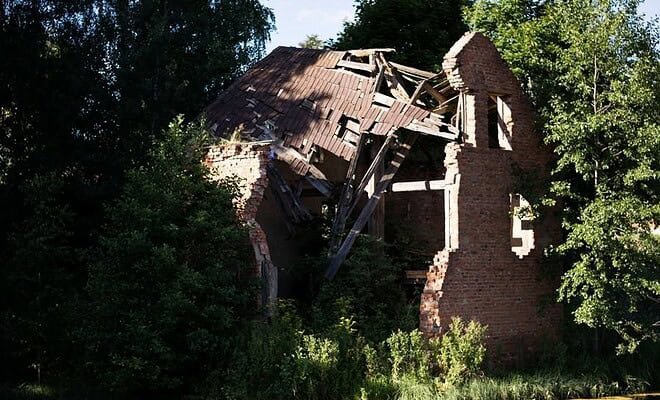
The forest’s maw yawned as native trees—silver bells, red ciders, magnolias, and maples—pushed away the sky. Its teeth, the ruined walls of a great estate, sprang from the low-lying foliage and delineated the summer sunlight into harsh shadows and warm pools.
“It must have been a beautiful house once.” Zoe, the group’s intrepid spearhead and full-time dreamer, squinted at the cracked stucco that reflected the sun’s ardent gleam. “Who lived in it last?”
“I bet it was a wretched old miser,” her best friend, Jade, said. Her head followed the cracks in the discolored whitewash until they met an empty window frame. “I can see him sitting in the kitchen. An old clock ticks and ticks. With each passing minute, his lips draw half a sip of tea from a chipped, cold mug as he emphatically demands—against the crawl of time—that he can save everything, even his tea. He’s fired the staff, except for the cook. But she’s just a fixture, one of many dusty sconces and cracked railings. Disuse muddles her tightening skin as her ghost traces the boundary of each room, exercising the house’s will to supersede its natural life.”
Elijah, Jade’s younger brother, shook his limbs in feigned fright. “Why’d you make it so creepy?”
“Look at it; it has to be creepy.” Jade flung her hand out towards the hollow place. Ivy flowed from the windows like tears. In every shadow, one could, with enough heart, see the old miser himself, counting every stone that made up the tattered walls. “I’d wager he’s buried there right now, still clutching the teacup as everything around him dies.”
“You’re missing the grandeur!”
“What grandeur?”
Zoe pointed. “Look at the arches over the windows and doorway. Imagine walking below the ceiling. I bet there was a beautiful chandelier. Oh! And dark wood floors that pull on you, anchoring you to the earth as the chandelier swings high above like the dazzling path of a forgotten constellation. Its candles flash and wriggle, and the crystals tremor as they fight to detain the light.
“I see dances too, under that crown of fire and diamonds! Ladies and gentlemen circle each other like preening birds. A blur of white-gloved waiters deliver foreign delicacies to guests before whispering life into rumors behind red curtains. There is a band too! Some nights it’s extravagant, with horns, cellos, violins, colliding like the scents of a hundred flowers. Other nights, two musicians sit together, their instruments gossiping until night trips over the rising dawn and golden ribbons of virgin light spill under the arches and through the doors.”
“How’d it become abandoned?” Jade asked.
“I don’t think it is. I bet that if we came back at night and listened carefully, we’d still hear the gallant waltzes, shuffling shoes, swaying laughter, and the tinkling glass.”
“That’s so flashy.” Kris, the group’s fourth member, cleared his throat. “Besides, this is probably the back of the house. See how the walls slope there? It’s the servant quarters and such; no chandeliers.” Kris drowned every conversation in the mire of logical minutiae.
“You can’t know that based on how the roof would slope,” Jade said.
“A structure this small wouldn’t have had a ballroom anyway.”
“You can’t even see the whole thing,” Zoe said. “There could be more through the trees.”
Kris shrugged and retreated behind his phone.
“No chandelier,” Elijah repeated. His eyes followed the path of a capricious squirrel. It ran along the stone gable, chattering wildly. It paused to pick seeds from between fissures in the wall before darting back into its nest pressed between the skeletal eaves. “But I imagine there were still dances. There,” he pointed to a resolute swath of trees that stood proudly in rows and looked down on everything with a refined indifference.
“That used to be a garden. An arbor or trellis is probably buried under that huge hedge. I bet children loved playing in all this cool shade. They’d run up from the creek, faces red and foreheads damp. The boys hold toads and lizards as they run after the girls, crisscrossing through the trees.”
“All of love’s firsts dance under dappled moonlight across the smooth flagstone. Witnessed by an orchestra of crickets and a solitary owl. But the children grew and eventually each took flight. I bet they all have their own gardens and their own walls. But even as new little ones scurry around table legs and over chairs, the adults can’t help but recall the towering trees and cool summer air that gave them wings.”
“Wilford Wendle bought the house in 1850.” Kris pocketed his phone. “And his son sold it in 1931. After that, it isn’t mentioned anywhere. Though Wendle is, both of them. Wilford Wendle died at Gettysburg leading a company of Confederates against Cemetery Hill. Says he was split in half by a cannonball. There isn’t much about his son except that he had four daughters. The youngest one married a forgotten Rockefeller, but then it’s just Rockefellers all the way down. So, guess that’s the house. Nothing else.”
A collective groan sizzled out at the mention of “confederate.”
“So, it was a plantation,” Jade muttered.
“I doubt it.” Kris’s keen eye cut across the forest like a prospector searching for the telltale signs of gold. “The ground isn’t suitable for cash crops here.” No one knew what to do with this nugget of wisdom, outdated in its usefulness, yet relevant in its moral implications. “He probably still owned slaves, though.”
Wind whipped at the branches and riled up the forest. They rattled and scraped against the abandoned frame like fingernails against a coffin.
“Maybe his granddaughters were nice,” Jade muttered. The house stared blankly through her into a foreign century. “They probably still danced.”
“And played in the garden,” Elija added as he looked deep into the mournful windows and crying mouth.
Editor: Shannon Hensley







Seth you have a magical way with words.
thank you!